1. Explain what happened to the man that was killed by the subway and how the photographer was able to take the photo.
The man in the picture was pushed by a panhandler into the tracks after he tried to calm down the panhandler, as he was harassing a passerby.
2. Why did the photographer say he took the photo?
The photographer said he was actually just using his flash to try to grab the conductors attention, to get him to stop the subway, not necessarily trying to take a picture.
3. Do you think the photographer should have taken the photo?
I'm going to say no. I don't know how far he was from the man but based on the photo it looks like he could have been saved. I think if the photographer was not trying to grab the attention of the conductor and was instead trying to save the man, his life could have been saved. Not necessarily for the ethics of the photo but ethics of life. If this was the photographer's response and he was too far to grab the man and yell for someone closer to help, then it's fine. It looks like he's close enough to truly pull him.
4. Do you think the photographer did the best thing he could have done in this situation? Why or why not?
I think if the photographer was not trying to grab the attention of the conductor and was instead trying to save the man, his life could have been saved. I'd say no. He could have yelled for help or tried to run fast to get to him. It doesn't look like there's much movement from him in the photo.
5. Do you agree or disagree with the decision to run the photo on the front page of the New York Post? Explain why or why not.
I'd say no. It's a picture that leads to something very gruesome and our imaginations get the best of us, having this on the front page leads to a bad taste. I think it could be okay in the inner pages of the paper but on the front is a lack of respect for everyone, especially the man who died and his family, he's not just a picture.
6. What is more important to a photojournalist, capturing images of life as it happens or stopping bad things from happening? Why or why not?
Capturing images of life happening. Journalist are invested in capturing stories not stopping them. It's not usually right for morality purposes, if you can do something.
7. Do you think it is ever ethically acceptable for a photographer to involve himself/herself in a situation that he or she photographs? Explain why or why not.
Yes. We're all allowed to have our own opinions so if you believe you are doing the best thing by getting involved, okay. If you involve yourself in a story and you are good at capturing the story, then involve yourself so you can explain it to others. It's a photographer's decision though.
8. Should photojournalists always avoid influencing events as they happen? Explain your answer.
Depending on ethics. If it's better for you to change the story because of ethics, do so. I don't think photojournalists should be afraid. If you see someone being held over a bridge and you're close to capture pictures but for the sake of a greater good, if you can intervene then do so. If you need to punch someone in the face to protect someone else, like the person who was dangling over a bridge, change the story. Life is not all a story, there is right and wrong.
9. After reading the responses from the professional photographers, what stands out as the most appropriate response for a photographer to this situation.
Not to photograph pictures that lead to doom as most do not agree with it.
Tuesday, December 17, 2019

Thursday, December 12, 2019

Thursday, December 5, 2019


Thursday, November 28, 2019
Using a projector
Link the website you visited and make sure your blog is titled the same as the links above.
https://petapixel.com/2015/01/01/projector-brought-forest-turns-nature-glowing-wonderland/
Briefly describe what you looked at on the website (2-3 sentences, make sure you write enough to really make it clear that you spent time looking at the website).
The website showed the behind the scenes of a project made by two men to see what the outcome would be of them projecting lights onto nature. They took a projector into the forest and made a film.
What did you learn new?
If there's no harm in trying something new within nature, you should go for it. Nature as a subject is very broad but you can find ways to add even more beauty and life to it artistically.
If possible, post your favorite photo from the site.
If you have a photo to post, please answer the following questions:
a. Why did you pick this photo?
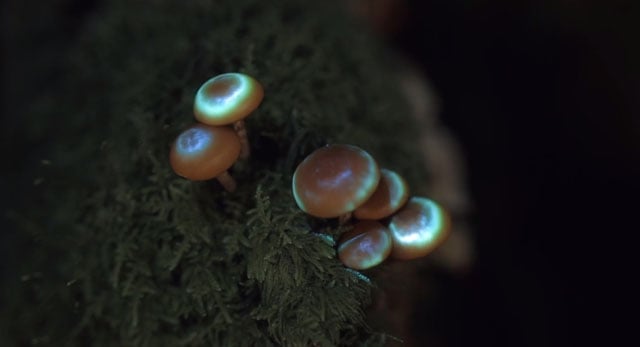
I chose this photo because I liked the colors and in the film I felt like it was one of the most artistic pieces because the light moved on the mushrooms as though it was a water droplet.
b. What rules of photography do you see in the photo?
I see the frame is focused on the mushrooms, so simplicity, although it's not that simple.
c. Who took the photo?
Tarek Mawad
If you looked at a video, please do the following:
a. Describe what you saw in the video.
In the video you get to see the camera and projector setup that the animator and photographer used in order to capture the light from the projector. You also see how they edited where they wanted the lights to go.
b. Try to figure out who made the video. If it was a photographer look them up on google and see if you can learn more about them.
Tarek Mawad
c. If there is a story about the video on the website, paraphrase it in 2-3 sentences.
You learn that they spent 6 weeks on the project and it was meant to accentuate the natural beauty of nature. The artists were interested in the silent beauty of nature.
d. What did you learn new?
They also made other films, such as Lucid. The films are meant to capture nature and landscapes.
https://petapixel.com/2015/01/01/projector-brought-forest-turns-nature-glowing-wonderland/
Briefly describe what you looked at on the website (2-3 sentences, make sure you write enough to really make it clear that you spent time looking at the website).
The website showed the behind the scenes of a project made by two men to see what the outcome would be of them projecting lights onto nature. They took a projector into the forest and made a film.
What did you learn new?
If there's no harm in trying something new within nature, you should go for it. Nature as a subject is very broad but you can find ways to add even more beauty and life to it artistically.
If possible, post your favorite photo from the site.
If you have a photo to post, please answer the following questions:
a. Why did you pick this photo?
I chose this photo because I liked the colors and in the film I felt like it was one of the most artistic pieces because the light moved on the mushrooms as though it was a water droplet.
b. What rules of photography do you see in the photo?
I see the frame is focused on the mushrooms, so simplicity, although it's not that simple.
c. Who took the photo?
Tarek Mawad
If you looked at a video, please do the following:
a. Describe what you saw in the video.
In the video you get to see the camera and projector setup that the animator and photographer used in order to capture the light from the projector. You also see how they edited where they wanted the lights to go.
b. Try to figure out who made the video. If it was a photographer look them up on google and see if you can learn more about them.
Tarek Mawad
c. If there is a story about the video on the website, paraphrase it in 2-3 sentences.
You learn that they spent 6 weeks on the project and it was meant to accentuate the natural beauty of nature. The artists were interested in the silent beauty of nature.
d. What did you learn new?
They also made other films, such as Lucid. The films are meant to capture nature and landscapes.
Great portraits
Link the website you visited and make sure your blog is titled the same as the links above.
https://www.picturecorrect.com/tips/how-to-take-great-portraits/
Briefly describe what you looked at on the website (2-3 sentences, make sure you write enough to really make it clear that you spent time looking at the website).
I learned different elements to put into a portrait in order to make it be a good one, like capturing your subject's personality in the picture. Location is also important in capturing personality, have your subject in a comfortable environment so that you avoid an awkward essence that isn't theirs.
What did you learn new?
Personality is the key element when taking a portrait to make it special.
If possible, post your favorite photo from the site.

If you have a photo to post, please answer the following questions:
a. Why did you pick this photo?
I chose this photo because I liked how the shadows give a dark feel but the facial expression creates a warm feeling.
b. What rules of photography do you see in the photo?
I see perspective and simplicity.
c. Who took the photo?
MorkiRo on Flickr
If you were directed to a site that you cannot answer any of the questions above, please do the following:
This site didn't lead me to anything else.
https://www.picturecorrect.com/tips/how-to-take-great-portraits/
Briefly describe what you looked at on the website (2-3 sentences, make sure you write enough to really make it clear that you spent time looking at the website).
I learned different elements to put into a portrait in order to make it be a good one, like capturing your subject's personality in the picture. Location is also important in capturing personality, have your subject in a comfortable environment so that you avoid an awkward essence that isn't theirs.
What did you learn new?
Personality is the key element when taking a portrait to make it special.
If possible, post your favorite photo from the site.
If you have a photo to post, please answer the following questions:
a. Why did you pick this photo?
I chose this photo because I liked how the shadows give a dark feel but the facial expression creates a warm feeling.
b. What rules of photography do you see in the photo?
I see perspective and simplicity.
c. Who took the photo?
MorkiRo on Flickr
If you were directed to a site that you cannot answer any of the questions above, please do the following:
This site didn't lead me to anything else.
The Disorienting Beauty of Spiral Staircases in Old Abandoned Buildings
Link the website you visited and make sure your blog is titled the same as the links above.
https://petapixel.com/2014/12/19/disorienting-beauty-spiral-staircases-old-abandoned-buildings/
Briefly describe what you looked at on the website (2-3 sentences, make sure you write enough to really make it clear that you spent time looking at the website).
The website demonstrated a series of pictures taken by German photographer, Christian Richter, all consisting of abandoned spiral staircases he found in abandoned buildings. He explored these buildings when he began taking photos.
What did you learn new?
I learned that you can find things to photograph in unconventional places, places not yet thought of which make your photos unique.
If possible, post your favorite photo from the site.
If you have a photo to post, please answer the following questions:
a. Why did you pick this photo?
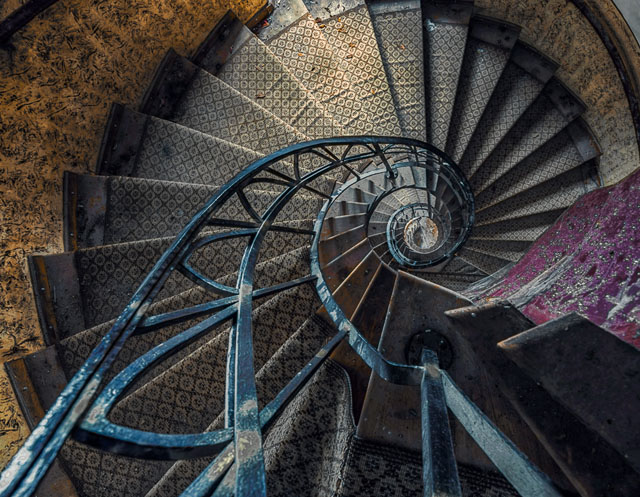
I chose this photo because it reminded me of the Fibonacci spiral.
b. What rules of photography do you see in the photo?
Using lines and depth.
c. Who took the photo?
Christian Richter.
If you were directed to a site that you cannot answer any of the questions above, please do the following:
It was directing me to his website but it said the domain was unavailable. I would have guessed that there was some information about the photographer and some of his photos.
https://petapixel.com/2014/12/19/disorienting-beauty-spiral-staircases-old-abandoned-buildings/
Briefly describe what you looked at on the website (2-3 sentences, make sure you write enough to really make it clear that you spent time looking at the website).
The website demonstrated a series of pictures taken by German photographer, Christian Richter, all consisting of abandoned spiral staircases he found in abandoned buildings. He explored these buildings when he began taking photos.
What did you learn new?
I learned that you can find things to photograph in unconventional places, places not yet thought of which make your photos unique.
If possible, post your favorite photo from the site.
If you have a photo to post, please answer the following questions:
a. Why did you pick this photo?
I chose this photo because it reminded me of the Fibonacci spiral.
b. What rules of photography do you see in the photo?
Using lines and depth.
c. Who took the photo?
Christian Richter.
If you were directed to a site that you cannot answer any of the questions above, please do the following:
It was directing me to his website but it said the domain was unavailable. I would have guessed that there was some information about the photographer and some of his photos.
Subscribe to:
Posts (Atom)